


Excurio: Multilingual Adaptation for Virtual Reality
Case Study


We already know that languages and accents are powerful storytelling tools. In film and television, they do far more than carry dialogue: they shape cultures, define identities, and influence how we perceive an entire fictional world. But sometimes, the best way to immerse your audience in a completely unknown world is simply to create a new language.
The emergence of constructed languages is closely linked to reflections on how language works and what it can achieve. One of the earliest known examples, Lingua Ignota, was created in the 12th century by Hildegard of Bingen, a German abbess and scholar. Constructed with invented vocabulary and alphabet, it wasn't created to serve as a spoken language, but rather to express spiritual and symbolic concepts. From a linguistic perspective, Lingua Ignota represents an early attempt to move beyond ancient inherited language systems by assigning new forms to meaning, even without a fully developed grammar.
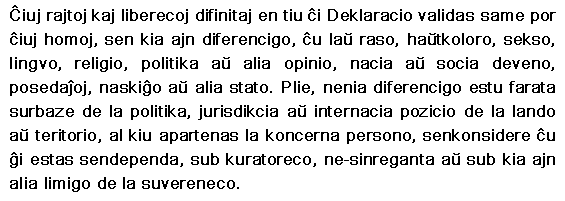
Modern conlang design took a very different form in the late 19th century with Esperanto, developed by Ludwik Lejzer Zamenhof and first published in 1887. Growing up in the linguistically diverse and politically charged city of Białystok, Zamenhof sought to create an easy-to-learn neutral international auxiliary language to help people of different native tongues communicate and foster understanding. After years of refinement, he self-published Unua Libro, introducing a language with a simple and regular grammar and a vocabulary drawn from several European languages. Esperanto was deliberately engineered for practical communication across language barriers and went on to attract an active global community, illustrating how a constructed language can function as a stable and expressive linguistic system.

A conlang, short for “constructed language,” differs from natural languages in the way it is created. While most human languages evolve organically over generations through social interaction, migration, and cultural exchange, conlangs are deliberately invented by an individual or a group. A conlang is designed with linguistic completeness, to function as a real language, with a conscious structure, including precise key features.
They are not a single category but a broad field commonly categorized according to their intended purpose, a distinction that helps clarify the wide variety of forms they can take. Artistic languages (artlangs) are created primarily for aesthetic and narrative expression, often to support worldbuilding in fictional settings. Engineered languages (engelangs), by contrast, are developed as tools for linguistic, logical, or philosophical experimentation, prioritizing structural innovation over ease of use. Finally, auxiliary languages (auxlangs) are intended to facilitate communication across linguistic boundaries, emphasizing neutrality and learnability rather than artistic effect. While these classifications are useful, they are not rigid, and a single conlang may occupy more than one category depending on its design goals and uses.
It's important to keep in mind that not all invented or stylized speech qualifies as a true language. For instance, Argots are specialized vocabularies or sociolects used by particular groups to signal identity, secrecy, or social affiliation; they modify existing language rather than creating a new linguistic system. Gibberish, by contrast, consists of sequences of sounds that may resemble words but lack consistent grammar, meaning, or rules, and cannot support meaningful communication. Both argots and gibberish can add style, character, or atmosphere in fiction, but unlike conlangs, they do not function as autonomous languages capable of expressing complex ideas.
Long before reaching the screen, conlangs - constructed languages, found their origins in literature. From meticulously imagined worlds on the page, writers began creating full linguistic systems with their own grammar, history, and internal logic. Then, these classics were adapted for the screen, making the conlangs feel even more real as actors had now to interpret them. As a result, many films and series have embraced linguistic construction not merely as a stylistic device, but as a narrative tool. In science fiction and fantasy in particular, conlangs help anchor fictional universes in realism, enhancing their coherence, cultural depth, and sense of authenticity.
Think about these iconic films like Avatar, The Hobbit and Lord of the Rings, or the series Game of Thrones. Making these movies involved more than filming scenes and telling a story, but meant creating entire universes from scratch, complete with history, culture, and language, so audiences could truly immerse themselves in imaginary worlds. One striking feature these films share is that the characters speak fictional languages, specifically invented for the story. This is where constructed languages, or conlangs, come into play. Far from random gibberish or improvised words, a well-designed conlang gives a fictional culture its own linguistic identity, with unique phonology, grammar, and vocabulary, yet crafted to feel tangible and culturally coherent. By doing so, filmmakers can anchor the universe in authenticity, giving the audience a richer sense of place, culture, and emotional depth. From a storytelling perspective, conlangs are not just a decorative element: they enhance immersion, support character authenticity, and reinforce the narrative world. Linguistically, they are fascinating because they mirror the complexity and diversity of natural human languages, providing insight into how language shapes culture, identity, and perception, all within a fictional framework. In essence, conlangs turn cinematic worlds into multi-layered experiences, where language itself becomes a bridge between the audience and the story.
Unlike natural languages, conlangs pose specific challenges for translators and localisation teams due to the way they are created. The main issue is that conlangs are purpose-built linguistic systems, which means they often lack a large base of speakers or documentation. The difficulty for the translator is to understand perfectly both the conlang and the target language deeply, to be able to make decisions regarding meaning, nuance, or tone. The most effective way to translate a conlang remains working in direct collaboration with its creator to establish rules, glossaries, and guidelines. This collaboration may also helps translators to be immersed in the fictional universe and more likely to spot elements that are unique to it, and got no equivalent in our real world languages.
Let’s dive into some of cinema’s most iconic universes through their languages.
Here's a list as a glimpse of the most iconic conlangs you've probably already heard!
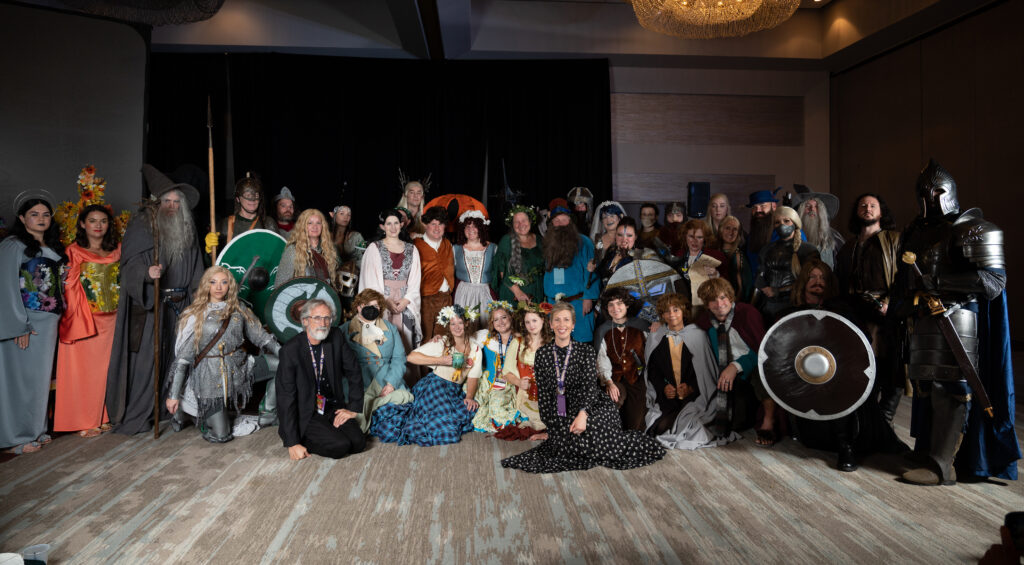
Beyond giving depth and credibility to cinematic universes and serving as a powerful storytelling device, conlangs help shape the culture of the fictional world and create a lasting connection with the audience. They foster a sense of community among fans, who engage with the language through study, creative projects, and shared experiences, and they cultivate fascination for the aesthetic and cultural richness of the language itself, reinforcing the immersive experience. Conlangs offer a unique and tangible connection to the film universe, turning what might otherwise be a passive viewing experience into an interactive process. Learning the language, practicing it with others, and exploring its structure allows fans to inhabit the fictional culture in a more personal way. Moreover, shared enthusiasm for a conlang helps form dedicated communities, whether online or at conventions, where fans exchange knowledge, collaborate on translations, and celebrate their common passion.



.webp)
.webp)