Picture this: a Japanese voice actor in Tokyo records their lines for a character, then sends the recordings to a localization team in Lille, France, which reviews, trims, edits, synchronizes ans mixes the audio tracks before delivering them to the final client, a virtual-reality studio based in Los Angeles, USA. This isn’t science fiction, it’s happening right now, and it’s transforming professional voice production. Yet remote voice recording has long had an image problem. Mention “home studio” to some audio professionals, and watch them wince.
Then COVID-19 changed everything almost overnight. When studios shut down, the industry had to adapt, and many discovered something surprising: remote recording actually works. Here’s the truth: when done properly, remote recording delivers exceptional quality while offering flexibility that traditional studios simply can’t match. The key element? “When done properly."This article explains when remote recording is worthwhile, how to make it work, what voice actors can do to deliver studio-quality performances from home, and the crucial role localization teams play in making it all happen.
Why Remote Recording is worth it.
In the era of artificial intelligence, voice production is at a turning point, facing unprecedented technological competition. So, beyond the obvious quality advantages of working with professional human actors, the industry must show resilience and offer solutions to compete with voice production that is fast, cheap, and limitless. Here’s why remote studios can be part of the answer:
🌏
Global Talent, Anywhere.
Remote recording opens up the entire world. Need a native Mandarin speaker, French-Canadian actors, or a British corporate narrator? They’re all available now. Multilingual projects that once required coordination across multiple local studios can now be managed from a single hub.
⏱️
Speed Through Asynchrony.
The beauty of remote recording is asynchrony: work happens around the clock without
coordination bottlenecks. Retakes are no longer rebooking nightmares. While traditional
studios record a handful of actors per day, remote workflows allow dozens to record
simultaneously across time zones.
💰
Smarter Budget.
You pay for talent and expertise, not facility overhead. Savings can be reinvested into
auditions, additional languages, and performance refinements. Remote production removes
travel, accommodation, and studio costs while giving teams more flexibility and faster delivery.
Let's Be Honest: There are Challenges.
While remote studios offer incredible flexibility and access to talent worldwide, they also come with their fair share of challenges.
Lack of Technical Support
There's no sound engineer physically in the room. In a traditional studio, the technician monitors levels and catches technical and sound issues in real-time. With remote recording, much of that responsibility shifts to the voice talent. That’s why preparation and partnership are crucial.
As a localization studio, we provide clear technical specifications upfront, verify equipment quality before recording begins, and offer support when issues arise. Voice actors with good equipment and who understand basic recording principles can absolutely deliver broadcast-quality audio independently.
Absence of Real-Time Artistic Direction
Another challenge is artistic direction. Remote guidance relies on detailed briefs, references, or source material, which makes it hard for the voice actor to fully grasp a scene or the precise emotional state of a character. And no one can give real-time feedback if the pace or performance starts to drift, mistakes are only noticed once the work is heard.
Does this require more preparation? Absolutely. Does it make great performances impossible? Absolutely not. Comprehensive briefs, clear references, and open communication channels solve most direction challenges. When projects require more hands-on guidance, clients and artistic directors can join remotely via video call or with professional audio routing software, providing real-time direction just like in a traditional studio. (Yeah, just without the human warmth.)
How Can Voice Actors Nail Remote Recording?
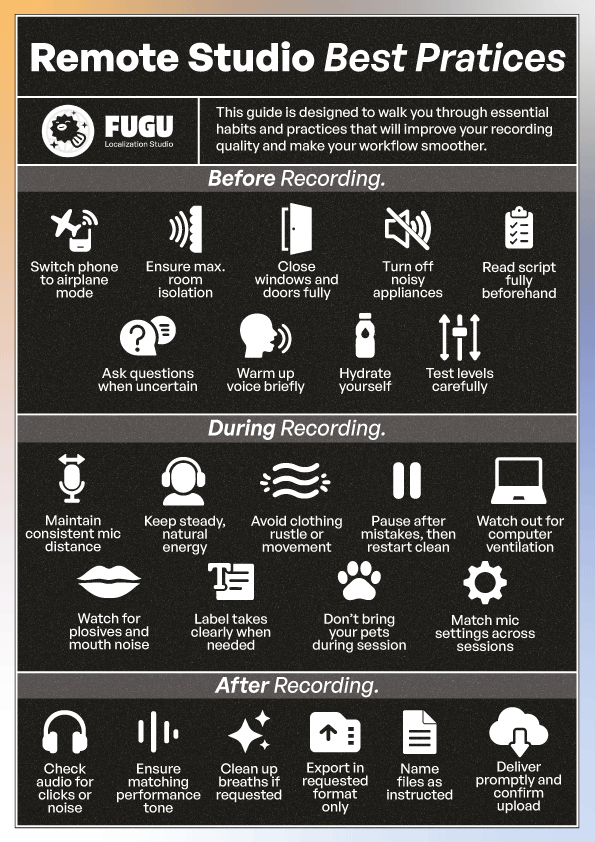
Before the session
Preparation is key to a smooth recording workflow. Find below the essential tips to ensure technical and performance quality.
Kill the Noise
Start with the right gear and a quiet, treated space.
Use a large-diaphragm condenser mic, a pop filter, a reliable interface, and an acoustic treatment. Clean recordings prevent unnecessary retakes or post-production work.
Do a technical check before recording. Check your room sound isolation then test your mic and levels.
Ace the Audition
Follow the brief closely and maintain audio consistency.
Check the final broadcast medium, understand the character and the requested style. Record multiple takes with varied energy and emotional choices.
Ask questions if something is unclear and show professionalism.
Get Yourself Ready
Warm up your voice and get yourself in the right state of mind.
Familiarize yourself with the script and the character. Understand the emotional journey of the character.
Minimize distractions and control your environment. Small disruptions can compromise recording quality.
During the session
With your space ready, your equipment checked, and your voice warmed up, it’s time to focus on delivering the right performance.
Technical Essentials
Always keep in mind your audio quality.
Keep a consistent mic distance and monitor levels carefully. Slightly under-recording is better than clipping audio, which ruins takes.
Listen to your first takes to make sure everything is OK and that nothing is disturbing the sound quality.
The Performance
Make sure the brief is 100% clear and detailed, to fully immerse into your character.
Watch out for acting variations, and emotional evolution. This can be indicated in notes. Match reactions to the scene’s tone.
Keep focus and maintain a steady energy. Even if a take feels perfect, record multiple versions.
Communication Wins Projects
Clear communication makes every project run smoother.
Confirm project details upfront, including deadlines and requirements.
Remain available after delivery. Prompt, clear communication builds trust and client confidence. React quickly to feedback and ask clarifying questions if necessary.
After you deliver
The final steps after recording are just as important as the performance itself. Careful attention to delivery and follow-up ensures your work is received clearly, professionally, and reliably.
Audio Integrity
Ensure your files are flawless and ready for use.
Listen through final takes carefully for clicks or disturbing noises. Catching issues early saves time for everyone.
Confirm performance tone matches across all takes. Consistency demonstrates professionalism.
File Management
Organized files simplify work for clients and editors.
Export only in requested formats and avoid extra processing. Use correct sample rate and bit depth.
If part of the job, trim your audio, name files exactly as instructed. Clear labeling keeps projects running smoothly.
Retakes
Pay close attention to the feedback before recording to prevent new issues.
Listen your takes to recreate the original recording conditions to match tone, pacing, levels, and mic position.
Label clearly by announcing or naming retakes so editors can spot them instantly. Approach revision requests collaboratively.
Common Sense Tips.
These tips might seem obvious, but following them carefully can make a huge difference in a smooth remote session. Trust us, we have experienced what happens when they are ignored!
How Localization Studios Make It All Work
Professional localization studios are the invisible force that turns individual remote performances into polished, broadcast-ready content.
🌐 Multilingual Expertise
Localization teams goes beyond translation the content. Teams perform rigorous script preparation, adapting text for cultural market while keeping in mind strictly to respect timing and lip-sync. This adaptation ensures every line fits the visual timing and rhythm, delivering a result that is both culturally authentic and technically precise. And that, in any language.
📅 Project Management
Schedules, time zones, and instructions, need to be coordinated seamlessly. Studios act as the bridge between voice actors and clients, clarifying notes and translating feedback into actionable guidance. A smooth workflow prevents confusion and keeps projects moving efficiently.
🎤 Selective Talent Casting
As we conduct worldwide auditions, our localization project managers select actors based on client requirements and carefully check their profiles and technical equipment. A shortlist of relevant voices is provided for the client to choose their preferred option.
⚙️ Technical Quality Control
Before recording, voice actors’ setups are verified to ensure audio quality and project compliance. The post-production team works to deliver clean, consistent audio by editing breaths, normalizing levels, and synchronizing, so the final delivery meets quality standards.
✅ Fine-Tuning
During the final stage, the localization team works closely with both the client and the voice actor to polish recordings. They coordinate retakes when necessary, provide guidance, ensure consistency, delivering a polished result that meets the project’s creative and technical standards..
🚀 The Bottom Line
Remote recording thrives when professionalism, technical capability, and localization studio oversight combine. It makes multingual voice production more flexible, cost-effective, and globally possible, without compromising the quality that traditional studios provide.
Bridging the Distance.
Remote recording breaks down geographical barriers, enabling productions to cast the perfect native voice for a role rather than settling for the best local option. It provides a strategic advantage by separating production from location, reducing turnaround times and overhead costs while maintaining broadcast-quality standards. Remote workflows bring speed and agility, but they are not effortless, careful handling is essential to achieve studio-grade results.
While not every content fits this model, it still opens a world of possibilities for a lot of adaptation projects. As a localization partner, we leverage our expertise to manage multilingual remote voice production projects efficiently, establish a cohesive workflow, and deliver a polished final product, demonstrating that with the right oversight, remote studios can be a way to keep human voice ahead.
publication date
Published on
14/4/2026
share this article
author
Studio Fugu
Anything else? Feel free to reach out to us at any time!
It can be challenging to coordinate multiple vendors, content types, and languages, especially when you need to reach global audiences quickly. That’s where we come in. We help you deliver the best experience to everyone, everywhere.







.webp)