


Video Game Localization Lost Records: Bloom & Rage
Case Study

As a Romance language, Spanish traces its origins to the Roman occupation of the Iberian Peninsula in the 3rd century BC. During this period, Latin Vulgaire was the dominant language, but following the fall of the Roman Empire, Latin evolved into various dialects across Europe. Among these, the basis of what would later become Castilian emerged in the northern region of present-day Spain. During the early Middle Ages, with the Reconquista, it gained prestige and became the language of administration and culture, eventually being used for official documents and standardized as a language under the reign of Alfonso X, “The Wise,” in the 13th century. As it became a kind of lingua franca within Spain, other regional languages and dialects continued to develop, such as Galician, Catalan, and Basque.
Today, Spanish is a truly global language, spoken by approximately 636 million people worldwide, including 519 million native speakers. It ranks as the second most natively spoken language in the world and the fourth most spoken language overall.
Spanish has spread across continents through centuries of exploration, colonization, and migration. Each region has adapted the language to its own social, historical, and geographic context, giving rise to distinct accents, vocabulary, and expressions. It today functions as a major international language, carrying institutional weight across global diplomacy, trade, and education. It is an official language of the United Nations, the European Union, the Organization of American States, and numerous regional bodies across Latin America, which makes it one of the world’s most used languages in multilateral communication. This wide reach is supported by a linguistic governance model: the Royal Spanish Academy (RAE) that works in partnership with 23 national language academies through the ASALE (Association of Spanish Language Academies) network. This collaborative structure ensures that regional varieties are recognized, codified, and represented in joint reference works such as the Diccionario de la lengua española. Today, what we call the "Hispanosphere" (refering to spanish-speaking world) encompasses more than 20 countries where Spanish is the official language, as well as numerous regions where it plays a central role as a second language.
Spanish is far from a monolithic language. Its regional varieties can differ significantly, particularly in pronunciation and vocabulary, while grammar tends to remain more consistent. European Spanish (also called Peninsular Spanish) differs in notable ways from the Spanish spoken across the Americas, and within both continents, numerous dialect areas exist. Linguists have identified certain varieties, such as Chilean and Honduran Spanish, as among the most divergent.
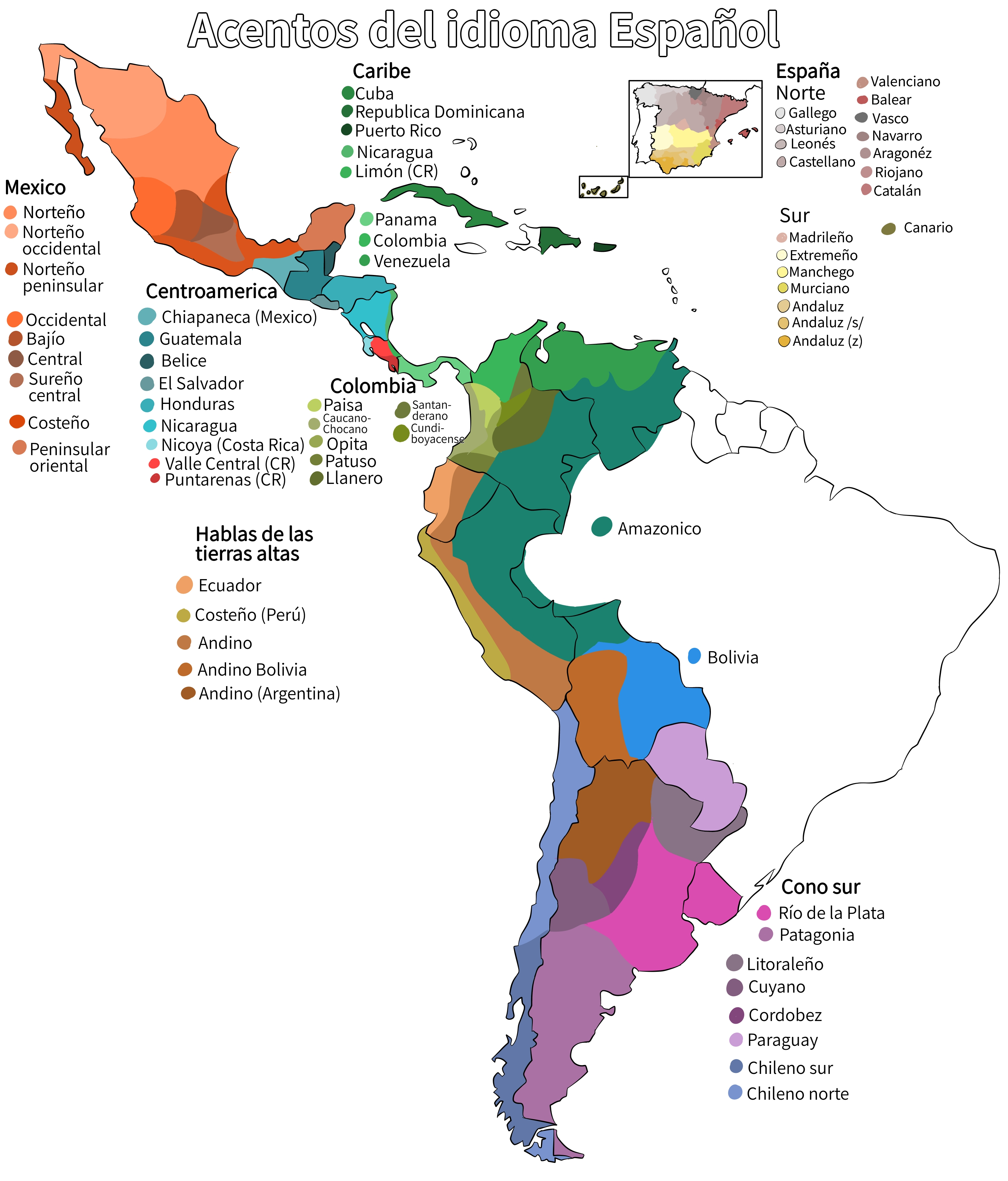
In Spain, Spanish is shaped by a wide range of regional accents and language contact zones. The official national variety is Castilian Spanish, which serves as the reference standard. In the north, Spanish coexists with historically rooted languages like Galician and Astur-Leonese that affect local speech patterns, while Basque (Euskara), as a fully independent, non-Romance language, influences rhythm and pronunciation in the Basque Country and Navarre. In Catalonia, Valencia, and the Balearic Islands, Spanish exists alongside Catalan, a distinct Romance language with its own grammar and standardization. In the south and central regions, accents such as Andalusian, Canarian, Murcian, Extremeño, Manchego, and Madrileño show greater phonetic variation, including consonant weakening and melodic intonation.
In Mexico, the umbrella regional variety of Español mexicano encompasses numerous local accents and sub-accents. In the north, we find Norteño, Norteño occidental, and Norteño peninsular. Moving toward central and western regions, accents such as Occidental, Bajío, Central, and Sureño central are forming the basis of a “neutral” Mexican Spanish. Along the coasts, Costeño and Peninsular oriental show more relaxed rhythms. Finally, in the south, Español chiapaneco (Chiapaneca) exhibits local phonetic traits and lexical influence from indigenous languages.
Similarly, across Central America, Spanish manifests as both national varieties and regional accents. Countries such as Guatemala, Belize, El Salvador, Honduras, and Nicaragua each have their own phonetic and lexical patterns, while in Costa Rica, Nicoya, Valle Central, and Puntarenas each accent carry subtle differences, with Nicoya and Puntarenas showing stronger Caribbean-like pronunciation. Valle Central follows a more standard one, and Panama exhibits Caribbean-influenced rhythms.
In the regions often designed as part of the Caribbean, Spanish is particularly dynamic. The Caribe dialect group includes Cuba, Republica Dominicana, and Puerto Rico, with features strong lexical influence from African and Taíno languages. Certain coastal regions of Central America, such as Limón in Costa Rica, share similar Caribbean traits.
Moving to Colombia and Venezuela, Spanish varies widely across regions. Colombia has an umbrella variety that includes Paisa (coffee region), Caucano-Chocano (Pacific coast), Opita (Tolima/Huila), Patuso (Southwest Colombia), Llanero (plains), Cundi-boyacense (Eastern Andes), and Costeño (Caribbean coast). Each dialect displays unique features, including indigenous lexical influences. Venezuelan Spanish also varies, from Caribbean-influenced coastal speech to central patterns in Caracas and voseo in Zulia.
In the Andean regions of Ecuador, Peru, and Bolivia, Spanish shows a split: Andean varieties preserve clearer consonants and slower tempo, while coastal accents may show Caribbean-like weakening. Southern Cone countries (Argentina, Uruguay, Paraguay, Chile) have multiple regional accents and dialects: Andino Argentina in the northwest, Rioplatense, Patagonia, Litoraleño, Cuyano, Cordobez, Paraguay Spanish, and Chileno norte/sur.
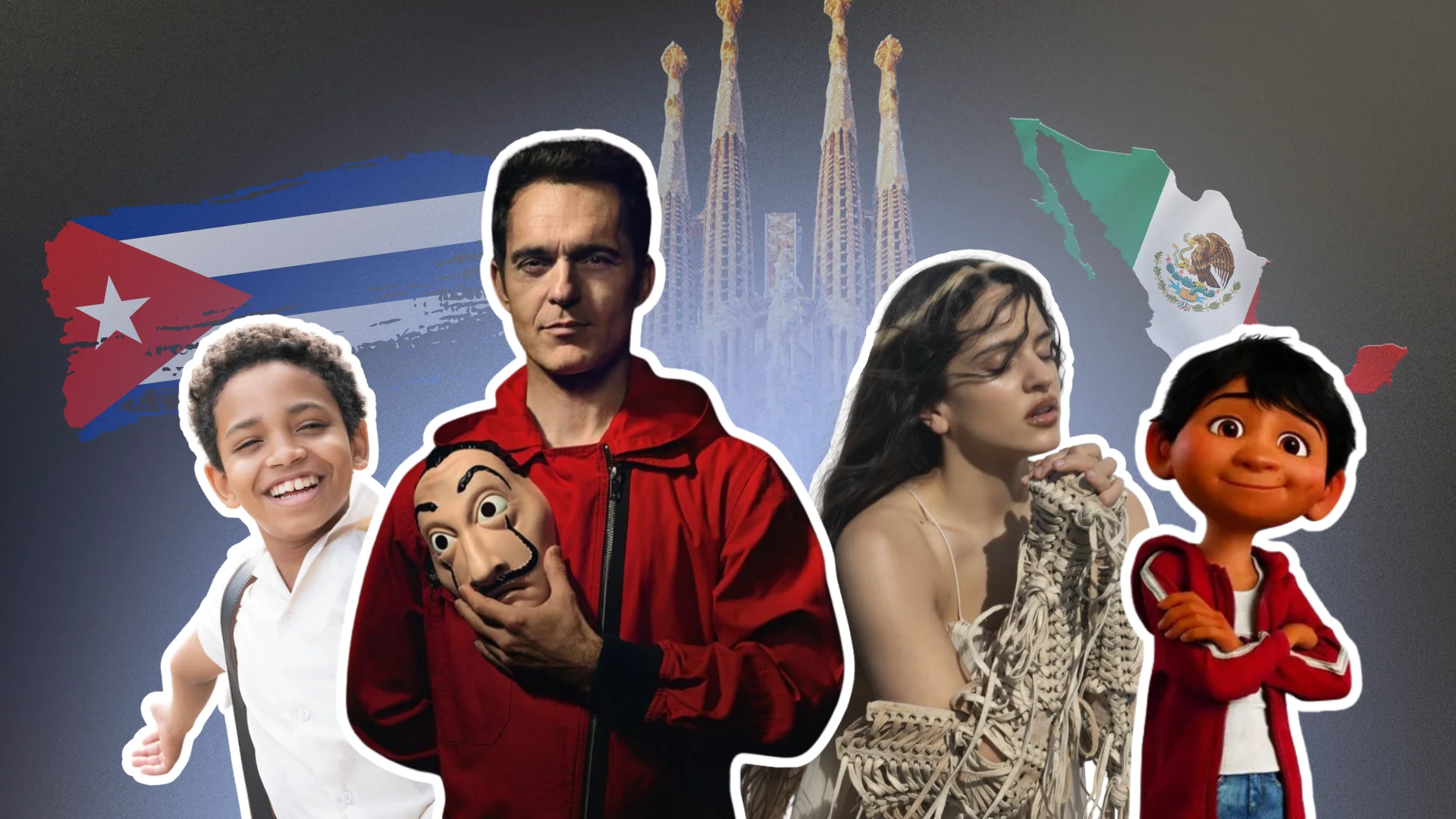
From a powerful empire to a modern cultural phenomenon, Spanish history has repeatedly influenced the world. The turning point came in 1492: under the reign of Isabella I of Castile and Ferdinand II of Aragon, the voyage of Christopher Columbus opened the Americas to Europe: a moment that marked the birth of the vast Spanish Empire. Castilian Spanish became the dominant language across the New World, and remains today one of the most spoken languages globally.
Back in Europe, Spain’s “Golden Age” (Siglo de Oro), from the late 15ᵗʰ to mid‑17ᵗʰ century, saw the emergence of remarkable arts and literature: writers, dramatists, and thinkers like Miguel de Cervantes helped define what modern European literature would look like with the iconic novel Don Quixote (early 1600s), which became a classic. Later, Spain produced world‑renowned painters such as Pablo Picasso, Salvador Dalí, and Joan Miró, whose groundbreaking works revolutionized modern art and influenced global culture. Centuries later, this legacy evolved into new forms of cultural power. Spanish-language literature, art, music, and storytelling diversified. In the 21st century, Spanish culture still influence the world, with for instance the hit series La Casa de Papel, Narcos and Elite, or more recently the successful singer Rosalía, who won 88 prizes including 2 Grammy Awards.

1492: His voyage opened the Americas to Europe, marking the rise of the Spanish Empire and spreading the Spanish language worldwide.

Miguel de Cervantes's iconic novel (early 1600s) shaped modern literature and became a timeless symbol of Spanish storytelling.

Master of surrealism, Dalí’s imaginative works influenced not only art but cinema, fashion, and popular culture worldwide.

Modern Spanish hit series on Netflix, watched globally, showcasing Spain’s contemporary cultural impact and storytelling power.
Spanish-speaking and Latino characters remain underrepresented in mainstream English-language film and television, often occupying less than 5 % of lead or speaking roles despite Latinos representing nearly 18 % of the U.S. population (according to Los Angeles Times). When present, they are frequently reduced to narrow stereotypes, with roles of criminals, hypersexualized women, immigrants, or comic relief, limiting on-screen diversity. Intersectional representation is even weaker: Latina women, LGBTQ+ Latinos, and Latinos with disabilities are largely invisible in top films and series according to USC Annenberg.
On television, shows like Jane the Virgin and One Day at a Time have intented to spotlight Latino lives and culture in a more authentic way, while series such as Breaking Bad or Narcos often reinforce criminal stereotypes of Mexican or Colombian characters. In contrast, Spanish-language films and series from Spain and Latin America, such as Roma, Pan’s Labyrinth, La Casa de Papel, and Y Tu Mamá También, have reached international audiences and critical acclaim when distribution is adequate. Streaming platforms like Netflix and Disney+ are improving visibility, but structural gaps constrain lasting change. Greater and authentic portrayals would better reflect reality and unlock new cultural and creative opportunities.
Spanish wears many voices. Let's hear them! Each region, each country, adds its own twist to the language. These cards let you hear Spanish in all its variety, through iconic movie characters. Keep in mind this list is just a glimpse, many more accents exist and continue to evolve every day, reflecting the living, dynamic nature of the language.

La Casa de Papel
Central & Northern Spain (Castile, Madrid) — clear enunciation, /θ/ for "c" & "z" (distinción), final-s retention, and strong consonant articulation.
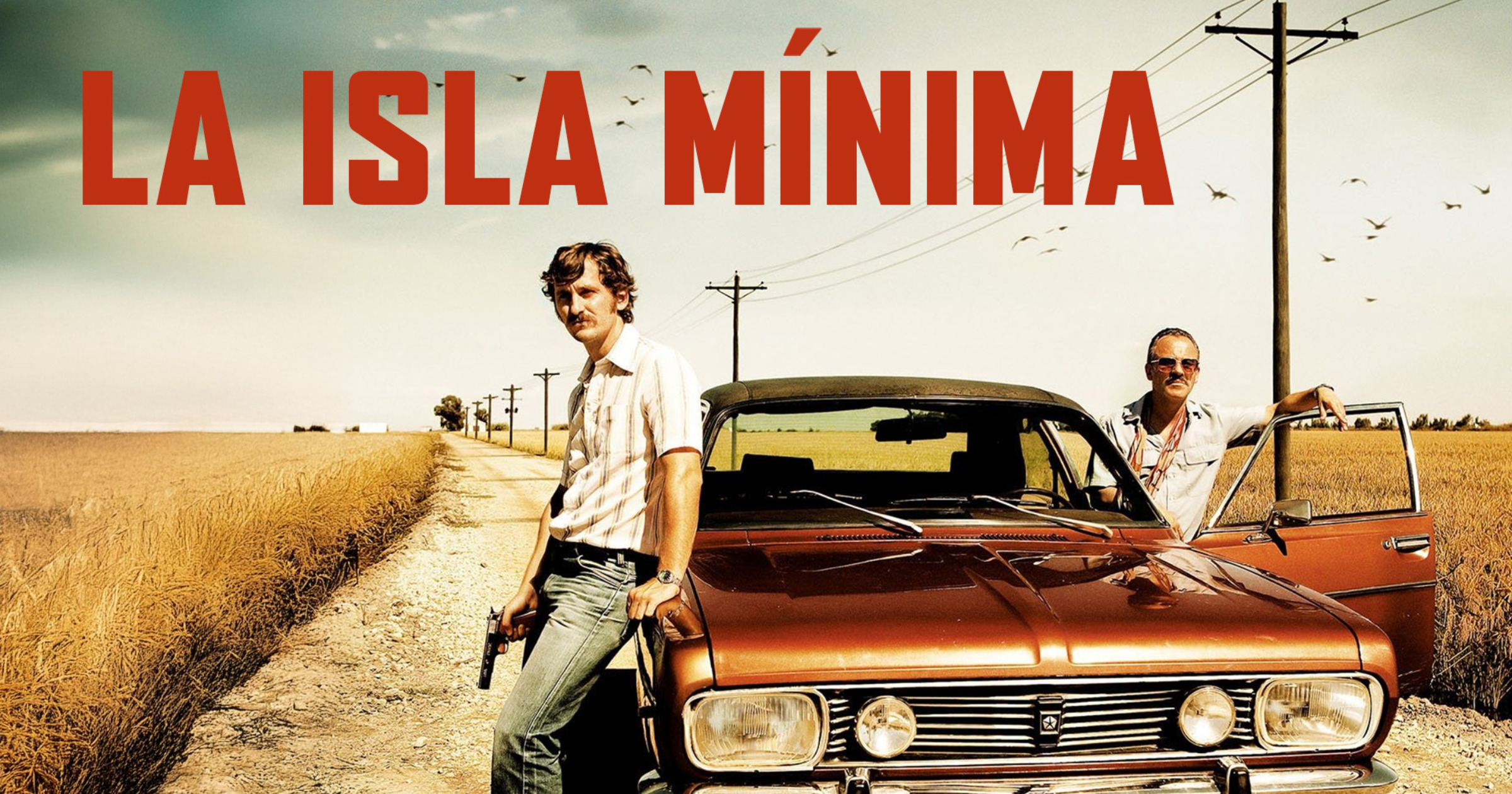
La isla mínima
Southern Spain (Andalucía) — soft, fluid, open vowels, marked by seseo (no θ), yeísmo, and frequent aspiration or dropping of final consonants.

El 47
Easter Spain (Catalonia) — Marked contrast of the vowel pairs /ɛ, e/ and /ɔ, o/, abundance of /w/ diphtongs as in Galician and Portuguese. Not only an accent but a language.*
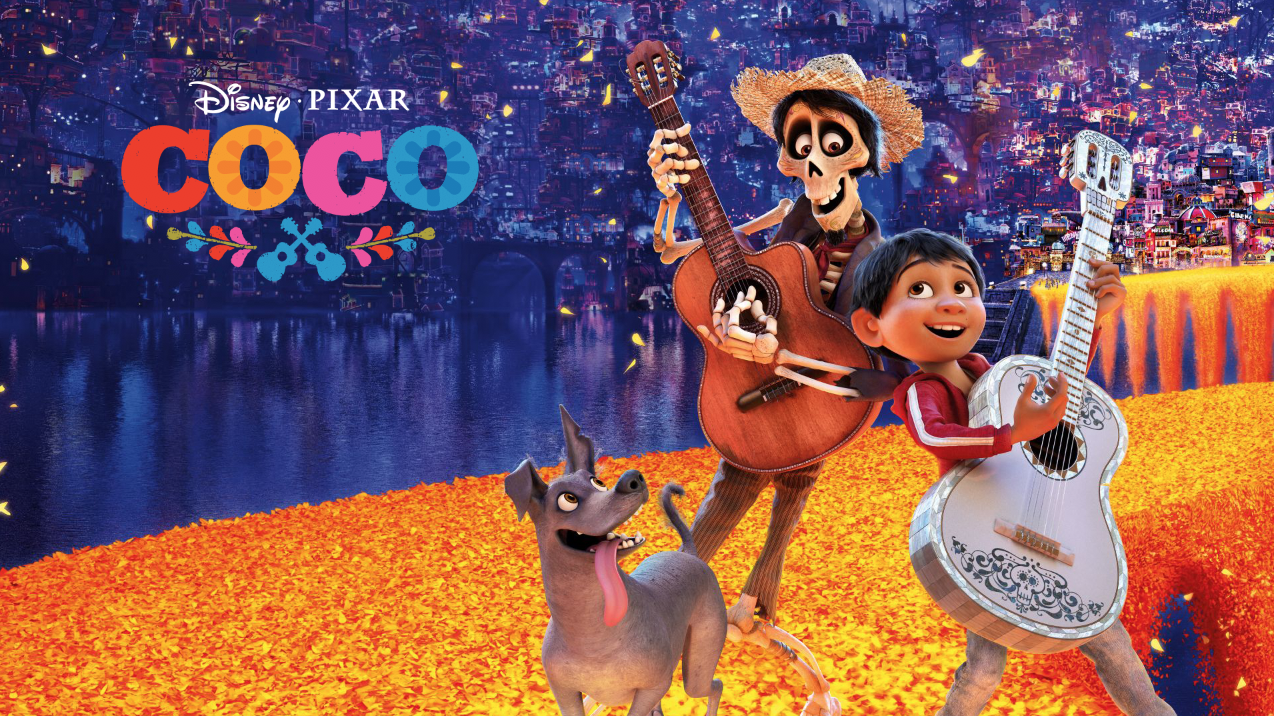
Coco
Central Mexico — relatively slow, clear pronunciation, neutral vowels, rhythmic, includes local idioms and colloquial expressions.

Yuli
Cuba — lively, musical, fast rhythm and distinctive vowel elongation, end consonants dropping (especially /s/), idioms and local expressions.

Esta isla
Puerto Rico — Lambdacismo (r sound shifts towards l), possible weakening or aspiration of syllable-final /s/. Sometimes called "Caribbean" accent, with influences from Canary islands and Southern Spain.
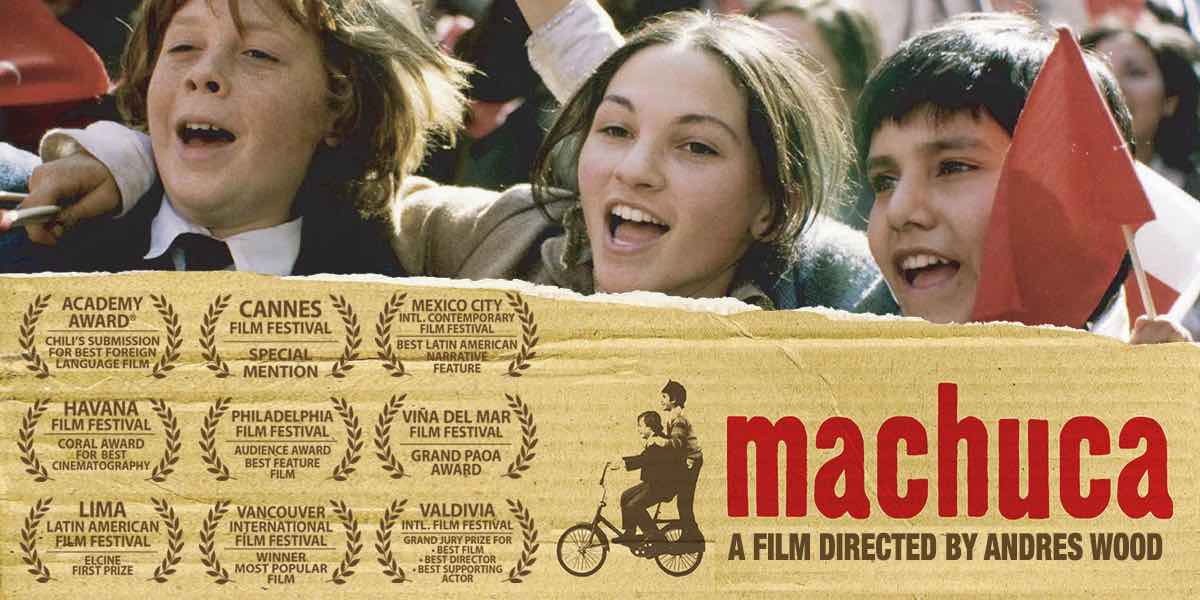
Machuca
Chile — fast pace, softened consonants elision of syllables, final /s/ often dropped, vowels can be redued or blended, unique slang and local expressions.

El Reino
Argentina — notable intonation with a marked rise-and-fall melody, strong influence from Italian prosody, use of voseo, “sh”/“zh” sound for “ll” and “y”, clear articulation of vowels, frequent local slang (lunfardo).

Simón
Venezuela — rhythmic and expressive intonation, clear vowels, softened or aspirated final consonants, fast pace in coastal areas, and abundant regional slang and Caribbean-influenced phrasing.

Retablo
Peru — clear articulation of /r/ and /ɾ/ and stable vowels, yéísmo, slow rhythm. Influenced by Andean dialects like Quechuan language.
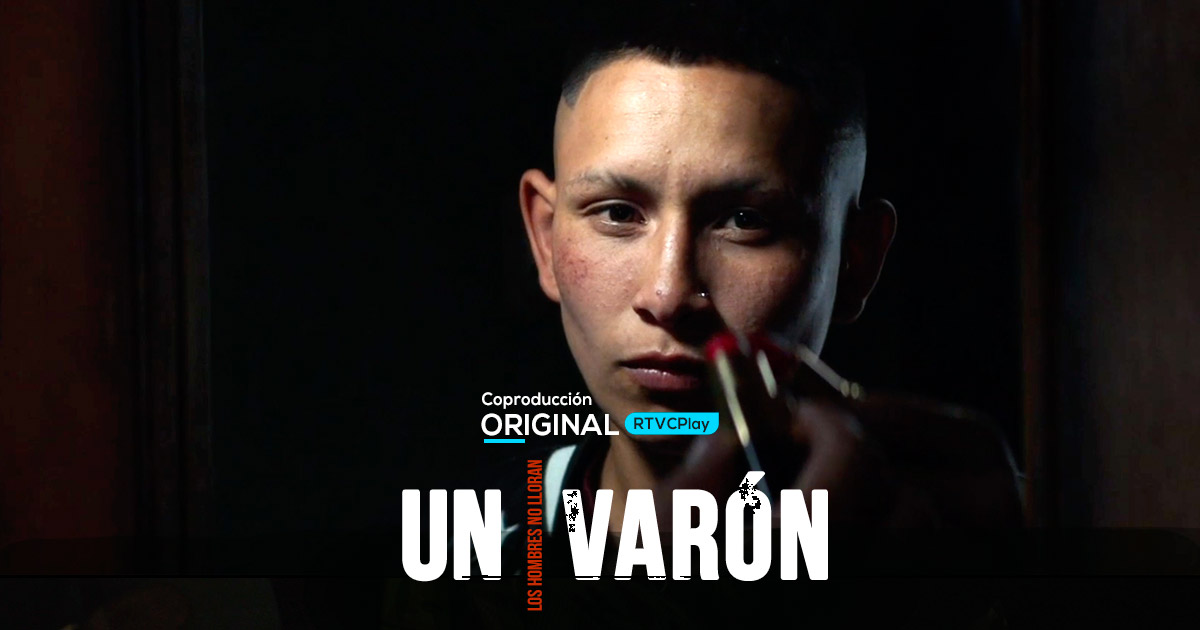
Un Varón
Colombia — clear and steady pronunciation, stable vowels, soft consonants, melodic intonation, and regional slang; coastal areas speak faster with more consonant weakening.

Entonces Nosotros
Costa Rica — clear and measured speech, consistent vowel quality, soft consonants, minimal syllable reduction, and distinctive local expressions including the characteristic use of *usted* in informal contexts.

Animal
Galicia (northwestern Spain) — a Western Ibero‑Romance language that evolved from medieval Galician‑Portuguese, officially recognized alongside Spanish in Galicia, with close links to Portuguese yet strongly shaped by local dialects and centuries of contact with Castilian.



.webp)
.webp)